Can We Replace the Herd?

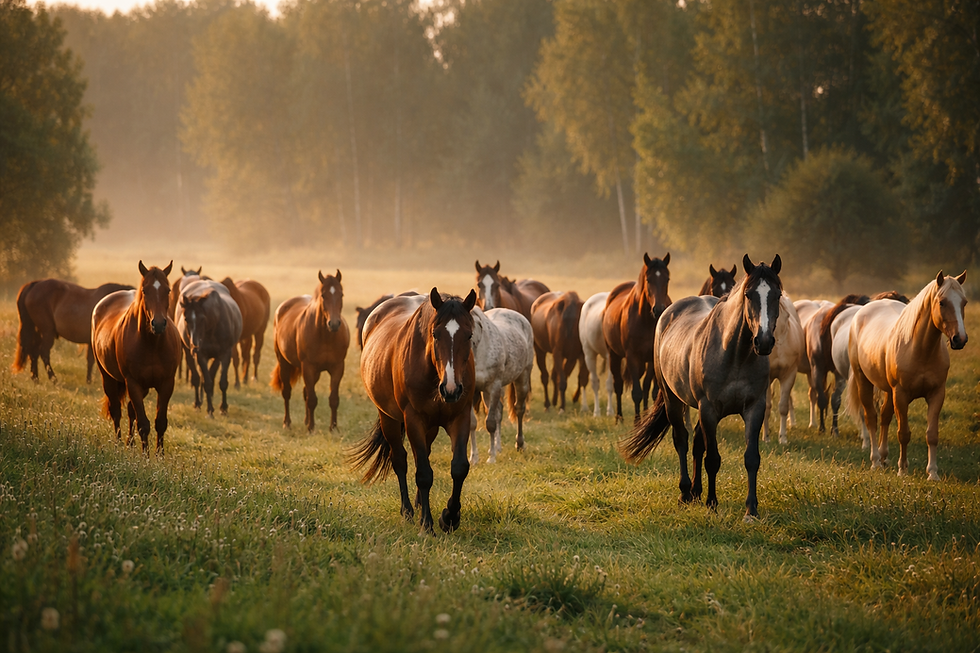
A quiet look at what horses really need when they’re alone
There is something deeply comforting about the idea that we, as humans, can become everything our horse needs.
We feed them. We care for them. We spend hours with them. We learn their personalities, their preferences, their patterns.
And sometimes, quietly, without meaning to, a belief begins to form:
“They have me… so they’re okay.”
It is not a careless thought. In many ways, it comes from love.
But when we look more closely - both through science and through the quiet, observable behaviour of horses - the picture becomes more complex.
The horse is not designed to be alone
Horses are not simply animals who prefer company.
They are animals whose nervous systems are built around it.
Safety, for a horse, has never been an individual experience. It has always been shared. The herd is not just companionship - it is surveillance, regulation, communication, and reassurance all at once. It is a living, responsive system that allows each individual to soften, rest, and recover.
When a horse is separated, even temporarily, that system is disrupted.
What we often see externally - calling, pacing, heightened alertness - is only the visible part. Underneath, there are shifts in physiology, in heart rate, in vigilance. The body is, quite simply, more prepared for danger.
And this matters, because regulation is not just about behaviour. It is about what the nervous system believes to be true.
Can humans step into that role?
A recent study explored whether a human could reduce the stress of short-term social isolation in horses through simple forms of interaction - stroking, speaking, or a combination of both.
The findings were quiet, but important.
Human presence alone did not strongly reduce stress responses.
There were small nuances. Geldings appeared to respond more positively than mares. A calm, familiar voice seemed to offer more support than touch alone, particularly in horses who were already relatively steady.
But overall, the message was consistent:
A human, even a kind and familiar one, does not fully replace the herd.
This is not a criticism of human–horse relationships. It is simply a reflection of biology.
When care looks like comfort - but isn’t quite
One of the more subtle challenges in horsemanship is learning to recognise the difference between a horse who is coping, and a horse who is truly comfortable.
A horse may stand quietly when alone. They may seek human interaction. They may even appear calmer when we are present.
But this does not necessarily mean their social needs are fully met.
It may mean:
they have learned that calling is not effective
they are conserving energy
they are orienting toward the only available source of reassurance
None of these are wrong. But they are not the same as deep, settled regulation.
And this is where it becomes easy, unintentionally, to overestimate the role we play.
The quiet value of what we can offer
None of this means that human interaction is irrelevant.
Far from it.
The study suggests that voice, in particular, may offer a small but meaningful layer of support - especially for horses who are already more emotionally regulated. Routine, familiarity, and calm handling all contribute to a horse’s sense of predictability, which in itself is valuable.
We matter.
But we are part of the picture - not the whole of it.
A more honest, kinder perspective
Perhaps the most helpful shift is not to see this as a limitation, but as clarity.
We do not need to replace the herd to be valuable to our horses.
Our role is different.
We can:
create environments where social needs are met as consistently as possible
minimise unnecessary isolation
support horses thoughtfully when separation cannot be avoided
recognise when behaviour is a reflection of unmet needs, not “naughtiness”


Comments