When a horse starts eating mud
- The Equine Information Hub

- Apr 5
- 3 min read
What it might mean, and what to consider first
Sometimes it begins quietly.
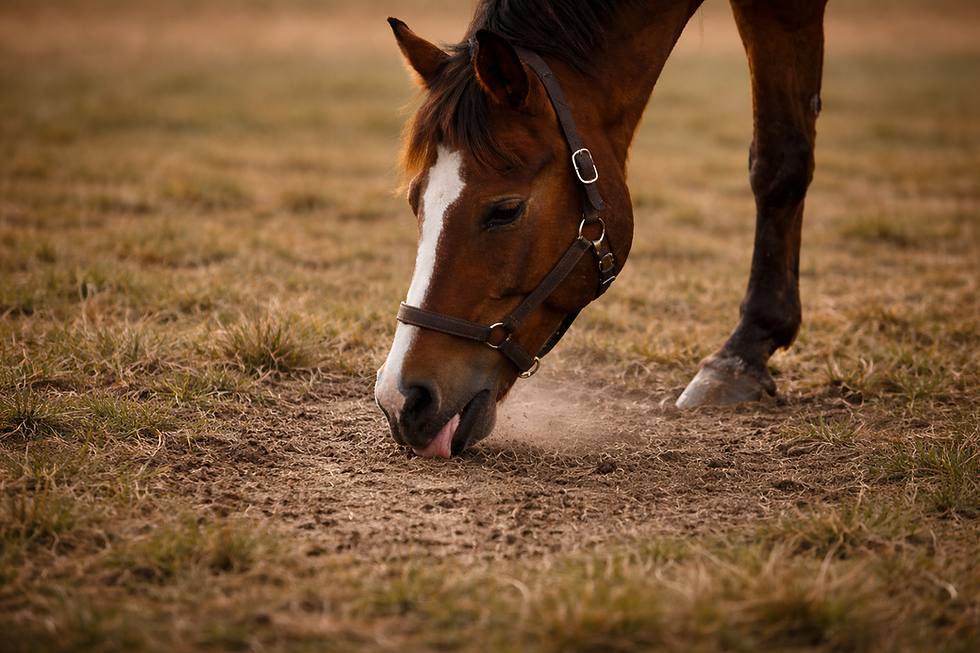
A horse lowers their head, not to graze, but to the bare patches. There is a pause, a shift in attention, and then a small, deliberate movement - licking, nudging, taking in soil rather than grass. It can be easy to dismiss at first. Horses investigate their environment in many ways, and not every unusual behaviour carries meaning.
But when it repeats, it tends to stay with you.
There is something about it that feels slightly out of place. Not urgent, not dramatic, but enough to prompt a question: is this normal, or is it telling me something?
A behaviour without a single answer
Eating mud, or soil, does not sit neatly into one category. It is not a behaviour with a single clear cause, and trying to assign it one too quickly can lead us away from what matters.
Sometimes it is exploratory. Horses use their mouths to gather information, and small amounts of soil ingestion can occur as part of normal grazing behaviour, particularly in sparse pasture or around well-used areas.
But when it becomes more deliberate - repeated, focused, or out of context - it is worth pausing to look a little more closely.
Not to label it, but to understand the pattern around it.
Looking at the wider picture
What matters most is not the behaviour in isolation, but the conditions surrounding it.
Has anything changed?
This might be obvious - a shift in forage, turnout, season, or routine. Or it might be more subtle: reduced grazing availability, increased time standing, changes in herd dynamics, or even a slight shift in workload.
Horses do not tend to do things “for no reason”, but the reason is not always where we first look.
Sometimes soil ingestion is linked to nutritional gaps. Not in a simplistic sense of a single deficiency, but in the broader picture of intake, balance, and availability. Horses may seek out different textures or materials when something within the diet is not quite aligning.
At other times, it sits closer to the digestive system itself. Low-grade discomfort, changes in gut function, or altered feeding patterns can all influence behaviour around food and ingestion.
And sometimes, it is environmental. Limited forage, boredom, or restricted movement can lead to behaviours that begin as exploration and become habitual over time.
Pattern recognition, not assumptions
It can be tempting to jump to a conclusion.
To decide that it is boredom, or deficiency, or simply “one of those things”.
But the more useful approach is to step back and look for patterns.
Is it happening at a particular time of day? In a particular place? In one area of the field but not another? Alongside any other small changes - in weight, droppings, coat, behaviour under saddle, or general demeanour?
Often, it is not one sign, but several quiet ones that begin to form a picture.
When to look more closely
There is a difference between occasional behaviour and something more established.
If soil ingestion becomes:
frequent
focused
or paired with other changes
then it moves from something to notice, to something to investigate.
This does not mean assuming the worst. It simply means allowing the behaviour to prompt a wider check-in.
Diet, forage availability, management, and comfort all come into that picture.
A calm place to stand
Not every unusual behaviour needs an immediate fix.
Sometimes what is needed first is a moment of observation - a willingness to watch without rushing to correct.
Because in many cases, the behaviour itself is not the problem. It is part of a larger conversation the horse is having with their environment, their body, or their management.
And when we slow down enough to listen to that conversation, the next step often becomes clearer.


Comments